
How to Search Chesterfield County Warrants
The Chesterfield County Police Department publishes an active warrant list online. It pulls from the department's Records Management System and is offered as a public aid. You search by typing all or part of a name into a single search box, then read the result cards. The list is large. On May 26, 2026, it held 4,577 results across 458 pages, which shows the scale of warrant service in the county.
The county's active warrants page carries the search box and the full disclaimer.
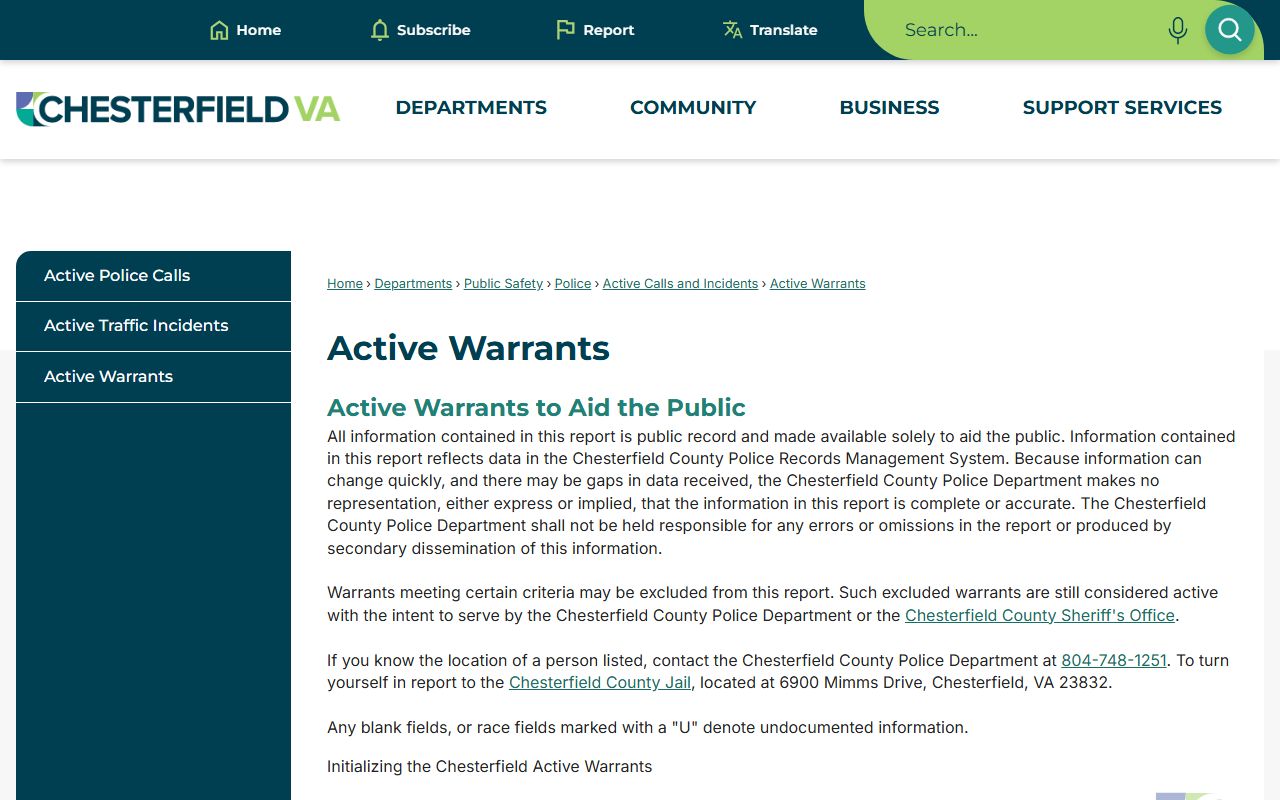
That page warns the data can change fast and may not be complete. Use these steps to run a search.
- Open the Chesterfield Police active warrants page.
- Type all or part of the person's name in the search box.
- Select Search and read through the result cards.
- Use the page controls to move through results if the name is common.
- Confirm any possible match carefully, since the listed fields are limited.
Do not treat the list as the final word. A name missing from the list does not prove there is no warrant.
Chesterfield Warrant Search Fields
The active warrant tool keeps the search simple. There is one name field and a search button, plus controls to page through the results. There is no advanced filter for charge type or date. That keeps the search fast but means a common name returns many cards to read.
| Field Label | Type | Required | Notes / Format |
|---|---|---|---|
| Search warrants by name | Text | Optional | Enter all or part of a name. |
| Search | Button | n/a | Runs the name filter. |
| Page number | Dropdown | Optional | Jump to a page; hundreds of pages are possible. |
| Prior / Next page | Buttons | Optional | Move through the result cards. |
Note: A broad name search returns more cards but fewer false misses, so start broad and narrow only if needed.
What a Chesterfield Warrant Listing Shows
Each warrant card holds a short set of fields. The list does not show an address, a warrant number, a court date, a bond amount, or a photo. Blank fields, or a race shown as "U," mean the data was not documented. The fields you will see are below.
- Name of the person the warrant names.
- Age and Year of Birth.
- Race and Sex.
- Date Issued for the warrant.
- Warrant type, such as Capias, Felony Warrant, or Misdemeanor Warrant.
- Charge, shown as a code section with short charge text.
A charge often appears as a code section plus a brief label, for example a failure-to-appear charge tied to a felony or misdemeanor offense. The charge text is short, so the full picture still comes from the court file.
The format takes a little reading. A card may show a Virginia code section, then a clipped charge description, then a local code and class suffix. A failure-to-appear on a felony offense, a violation of a pretrial release condition, or a similar entry all follow that same pattern. The class suffix hints at the offense level, but it is not a substitute for the court record. To learn the real status of the underlying case, search the person's name in OCIS and pull the court file, since the warrant card alone will not tell you whether the case has been resolved.
Types of Chesterfield Warrants
The list shows a few warrant types, and the labels matter. They tell you roughly how serious the matter is and how it arose. The terms below come up most often on a Chesterfield warrant card.
- Capias
- An order to arrest, often issued after a failure to appear or a violation of a court condition.
- Felony Warrant
- A warrant tied to a felony charge, the most serious class of offense.
- Misdemeanor Warrant
- A warrant tied to a misdemeanor, a lower-level offense than a felony.
- Bench warrant
- A warrant a judge issues, commonly for failing to appear or for contempt.
Whatever the type, an active warrant means law enforcement has authority to make an arrest. The safest response is to deal with it through the proper channel rather than wait.
Limits of the Public Warrant List
The active warrant list is helpful, but it has real limits the county states plainly. Information can change quickly, and there can be gaps in the data the department receives. The Police Department makes no promise that the report is complete or accurate and is not responsible for errors, omissions, or secondary use. Some warrants that meet certain criteria are left off the list entirely. Those excluded warrants are still active, with intent to serve by police or the Sheriff's Office.
Because of that, the list cannot be used as proof that a person has no warrant. If a legal consequence rides on warrant status, confirm it with law enforcement, the court, or an attorney. For full criminal case detail, see the Chesterfield County arrest records page and the court records page.
Warrants are served by people, not by the website. The Sheriff's Office Civil Process Unit serves criminal warrants, subpoenas, summonses, and orders, and deputies supervise evictions and levies. So a warrant can be acted on at any time, whether or not it shows online. That is the practical reason the county tells people to resolve a warrant quickly rather than wait for it to drop off a public page.
What to Do If You Have a Warrant
If you find your name on the list, handle it through the right office. The official guidance is direct. To turn yourself in, report to the Chesterfield County Jail and ask for a deputy. If you know where a wanted person is, the police take that information by phone. Follow these steps.
- Confirm the match carefully, since fields are limited and some data may be blank.
- To surrender, report to the Chesterfield County Jail front lobby at 6900 Mimms Drive and ask for a Deputy Sheriff.
- To report a wanted person's location, call Chesterfield Police at 804-748-1251, or 911 if it is urgent.
- For bond, the Magistrate's Office adjoining the jail handles bonding 24 hours a day at 804-748-1410.
- After surrender or arrest, release timing depends on magistrate and court action, bond, and jail out-processing.
Bond After a Warrant Arrest
Bonding does not happen at the court clerk's counter. All bond activity takes place at the Magistrate's Office adjoining the jail, which stays open around the clock. A third party, such as a friend, a family member, or a bonding company, can post bond. For an inmate's bond status, the jail line is 804-748-1476. Even after a bond is posted or a court orders release, the person may wait up to two hours to physically leave while paperwork is verified.
For more on custody and release after a warrant arrest, see the Chesterfield County inmate records page and the released inmates page.
The cards below pull together the offices you may need when acting on a Chesterfield warrant.
Chesterfield County Police
Report a wanted person
804-748-1251
Emergencies: 911
County Jail (Turn-In)
6900 Mimms Drive
Chesterfield, VA 23832
804-748-1476
Magistrate's Office
Bonding, open 24/7
Adjoining the County Jail
804-748-1410
One warning is worth repeating. The Sheriff's Office says it will never call to demand money over an outstanding warrant or a missed court date. A caller who threatens arrest unless you pay by phone or gift card is running a scam.
Protective Orders and Related Court Matters
Some warrants grow out of court orders. A protective order is a civil court order meant to protect a person, and violating one can lead to a new charge and a warrant. Protective orders are kept out of the public online case systems for safety, so they do not appear the way a traffic case does. Virginia's self-help site explains how these matters work.
The Virginia protective orders self-help page covers the basics for people on either side of an order.
If a warrant ties to a family or household matter, the case may sit in the J&DR Court. The Chesterfield Circuit Court page explains how the trial courts and district courts divide that work.
Protective-order violations are taken seriously and can move fast. A new charge can lead to a fresh warrant and an arrest the same day. Anyone served with an order, or anyone who believes an order has been broken, should rely on the court and law enforcement rather than the public warrant list, which may not reflect a brand-new warrant yet. The Victim and Witness Assistance Program, run free of charge by the Commonwealth's Attorney's Office at 804-796-7087, can help a protected party with court steps.